


Why study Electronics?
Electronics sits well alongside Physics, Mathematics, Computing, IT. It provides students with opportunities to develop their logical thinking and practical problem solving skills. This is useful in the world of work, apprenticeships, or in a degree. It is a subject that requires good mathematical skills as well as the ability to analyse observations and convey ideas clearly and concisely, as well as good organization and time management skills.
If you choose this course you would benefit from:
- Very experienced teachers.
- The opportunity to go on trips.
- Excellent individual support, outside class times and comprehensive on-line support.
- Excellent facilities and equipment.
In the first year you will study:
- Semiconductor components
- Logic systems
- Operational amplifiers
- Timing circuits
- Sequential logic systems
- Microcontrollers
- Mains power supply systems
In the second year you will study:
- Operational amplifiers
- Signal conversion
- AC circuits and passive filters
- Communications systems (inc Wireless, Digital, Optical)
- Instrumentation systems
- Sequential logic systems
- Microcontrollers
- Mains power supply systems
- High power switching systems
- Audio systems
- Practical Project Coursework
What will I be taught?
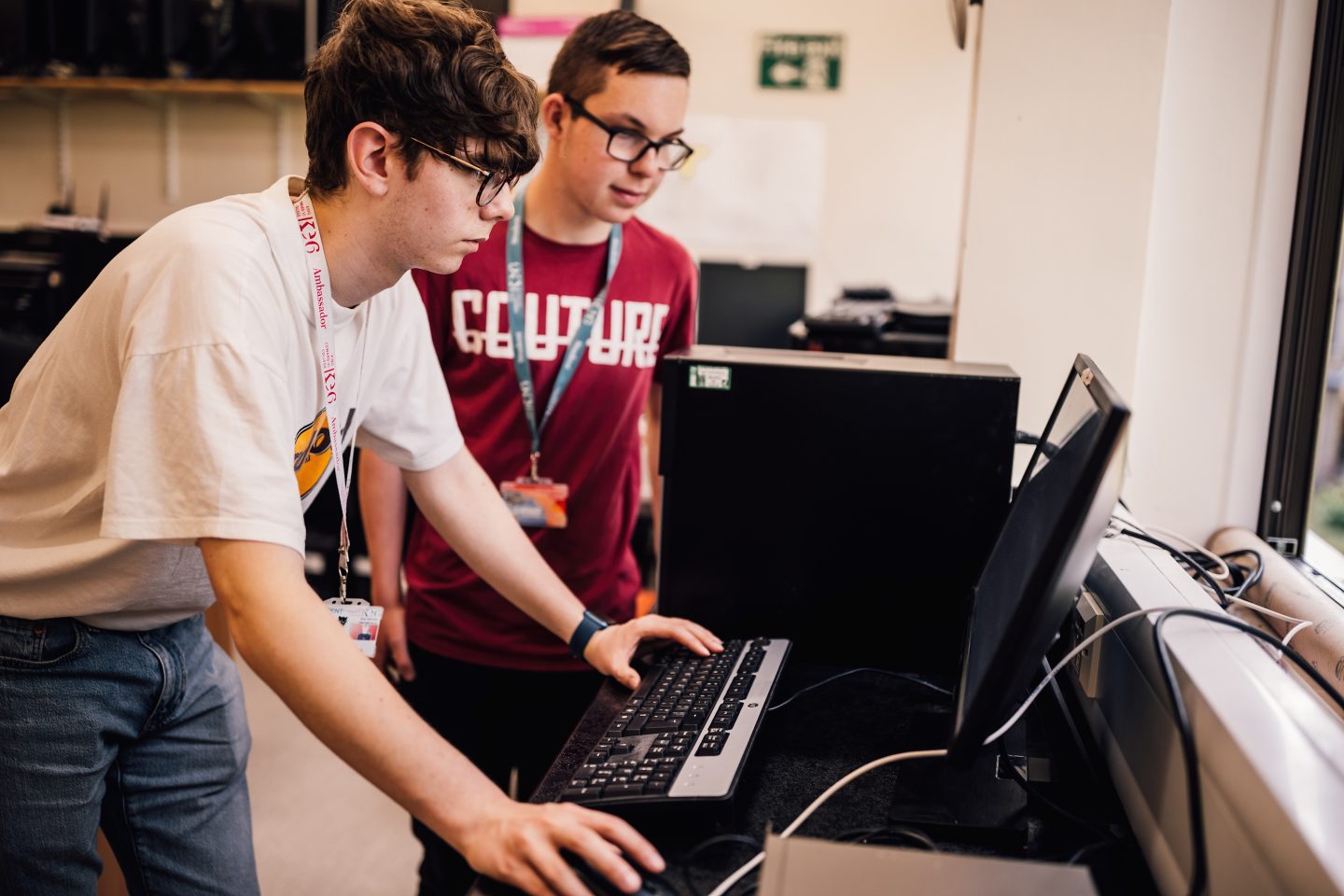
All Electronics lessons take place in a dedicated and well-resourced laboratory. Teachers use a variety of approaches in the delivery of the subject, including class discussions and questioning, paired activities, computer simulations and a large amount of individual practical work.
Students are expected to spend at least as much time on their work outside the classroom as inside. There are regular practical assignments to be working on, as well as homework questions, preparing for routine progress tests, and later in the course there is individual project work to do towards the final assessment. Students are able to enter the laboratory at almost any time of the day, to continue their work in their own time.
Based on research into how students learn best, each subject will set independent work to allow you to recap what you have done in the past, consolidate understanding for what you are studying in the present and develop the skills and experiences which will help you for the future. You can read more about the college’s approach to independent study here
The Past
Click here for the suggested ongoing revision activities in this subject which research has shown are most likely to boost your achievement
The Present
Each subject will set weekly homework tasks to help you consolidate your understanding and prepare for your next lesson. This work is typically set through Microsoft Teams, so you will have an electronic log of all your work, notes and feedback.
The Future
A key part of your independent work in this subject will be to prepare for a range of potential jobs and higher education courses when you leave us. To get started, look below at the top higher education courses and jobs which previous students of this course have gone on to do.
As part of a wider programme this course provides an excellent basis for progression to many careers or university courses.
Many former Electronics students of this college have gone on to study a wide range of Engineering disciplines, including electronics, but many students have also gone on to apprenticeships including JLR, and BAE Systems.
(Entry requirements are reviewed periodically and may be revised)
How many hours per week?
Teaching contact time is 4 hours and 30 minutes per subject. Other workshops will be available throughout the year including over some holiday periods. Students are expected to complete at least 4 hours and 20 minutes of independent study to complete homework, review topics and independent research.
5 x GCSE grades 4-9 (incl. English Language).
Additional Requirements
5 in Maths
5, 5 in Sciences
5 in English Language or Literature.
Not essential but will help your success…
Commitment and enthusiasm for Electronics.
Pairs well with Physics, Engineering and Computer Science. We recommend that you take Mathematical Studies if not taking A Level Maths. Ideal if you’d prefer to do a course based on final exams only.
There are two written examinations at the end of the two year course, each worth 40% of the marks, and during the two years you will complete two coursework projects worth a total of 20% of the total mark.
Staff Contact Details
Latest news from the college

Another Year of Positive Results and Student Achievement
King Edward VI Sixth Form College (KE6) is proud to announce another year of improved results, reinforcing our position as one of the region’s most successful and ambitious post‑16 providers. This year, KE6 achieved a 4% increase in achievement rates, meaning more students than ever are completing their full two‑year programmes and successfully passing their …
Read the story
Edinburgh Trip with Creative Arts Students
Edinburgh Creative Trip 2025! What an unforgettable adventure! Our 16th annual college trip to Edinburgh was a huge success — from exploring the historic streets and castles to soaking up the vibrant arts scene. The students made some amazing memories, shared so many laughs, and left inspired. Can’t wait for the next one!
Read the story
2025 A Level Grade Boundaries
Wondering if one of your papers might qualify for a remark? See how close you were to the grade boundaries here.
Read the story